

How Much Current Does The Shift Register Draw
Flip flops can exist used to shop a single fleck of binary information (1or 0). Nonetheless, in order to store multiple bits of data, we demand multiple flip flops. Due north flip flops are to be connected in an order to store northward bits of data. A Register is a device which is used to shop such information. It is a grouping of flip flops continued in series used to store multiple $.25 of data.
The information stored within these registers tin be transferred with the assistance of shift registers. Shift Register is a group of flip flops used to store multiple bits of data. The bits stored in such registers can be made to move within the registers and in/out of the registers by applying clock pulses. An north-bit shift register can be formed by connecting due north flip-flops where each flip flop stores a single flake of information.
The registers which will shift the bits to left are chosen "Shift left registers".
The registers which volition shift the bits to right are called "Shift right registers".
Shift registers are basically of four types. These are:
- Serial In Serial Out shift register
- Serial In parallel Out shift register
- Parallel In Serial Out shift register
- Parallel In parallel Out shift register
Serial-In Serial-Out Shift Register (SISO) –
The shift register, which allows serial input (one bit after the other through a single information line) and produces a series output is known as Serial-In Serial-Out shift register. Since there is but one output, the data leaves the shift register 1 flake at a time in a serial pattern, thus the name Serial-In Serial-Out Shift Register.
The logic circuit given below shows a serial-in serial-out shift register. The excursion consists of four D flip-flops which are connected in a series manner. All these flip-flops are synchronous with each other since the same clock indicate is applied to each flip flop.
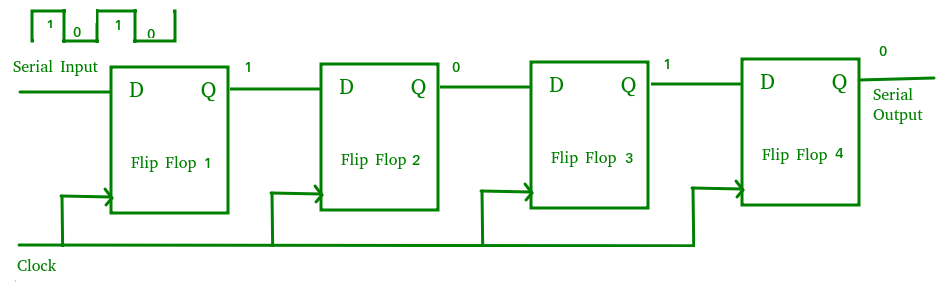
The to a higher place circuit is an example of shift right annals, taking the serial data input from the left side of the flip flop. The principal use of a SISO is to human action as a filibuster element.
Serial-In Parallel-Out shift Register (SIPO) –
The shift register, which allows serial input (1 bit after the other through a unmarried data line) and produces a parallel output is known every bit Series-In Parallel-Out shift register.
The logic circuit given below shows a series-in-parallel-out shift annals. The excursion consists of 4 D flip-flops which are connected. The articulate (CLR) indicate is connected in addition to the clock indicate to all the 4 flip flops in order to RESET them. The output of the outset flip flop is connected to the input of the next flip flop and then on. All these flip-flops are synchronous with each other since the aforementioned clock signal is practical to each flip bomb.
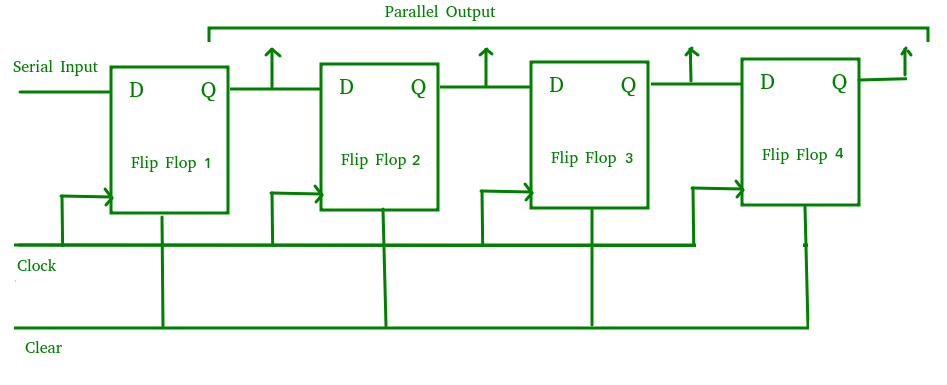
The higher up excursion is an example of shift right register, taking the serial data input from the left side of the flip bomb and producing a parallel output. They are used in advice lines where demultiplexing of a data line into several parallel lines is required because the primary apply of the SIPO register is to convert serial data into parallel data.
Parallel-In Serial-Out Shift Register (PISO) –
The shift annals, which allows parallel input (data is given separately to each flip flop and in a simultaneous manner) and produces a series output is known as Parallel-In Series-Out shift annals.
The logic circuit given below shows a parallel-in-serial-out shift register. The circuit consists of four D flip-flops which are connected. The clock input is direct connected to all the flip flops merely the input data is connected individually to each flip bomb through a multiplexer at the input of every flip bomb. The output of the previous flip bomb and parallel information input are connected to the input of the MUX and the output of MUX is connected to the next flip flop. All these flip-flops are synchronous with each other since the same clock signal is practical to each flip flop.
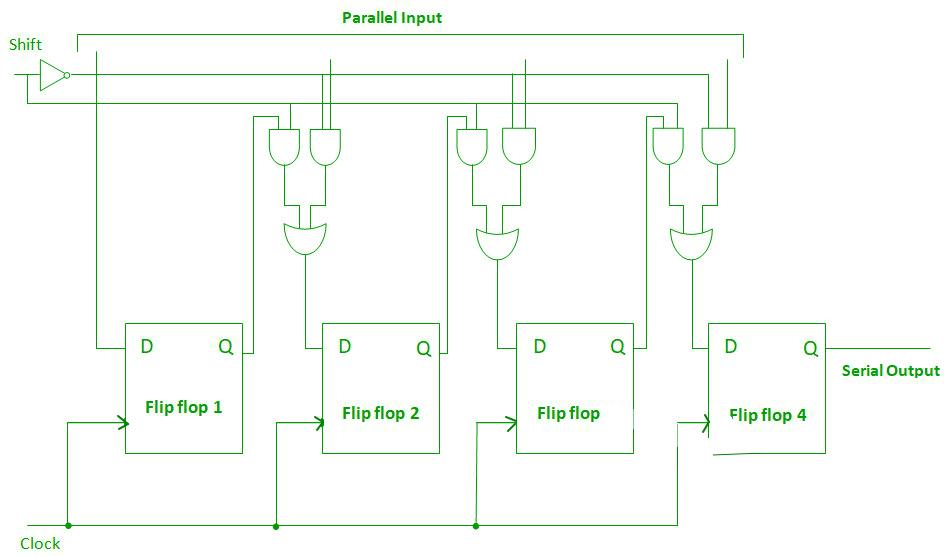
A Parallel in Serial out (PISO) shift register us used to convert parallel information to series information.
Parallel-In Parallel-Out Shift Register (PIPO) –
The shift annals, which allows parallel input (information is given separately to each flip flop and in a simultaneous fashion) and too produces a parallel output is known as Parallel-In parallel-Out shift register.
The logic circuit given below shows a parallel-in-parallel-out shift register. The circuit consists of four D flip-flops which are connected. The articulate (CLR) signal and clock signals are connected to all the 4 flip flops. In this type of register, at that place are no interconnections between the individual flip-flops since no serial shifting of the information is required. Data is given as input separately for each flip flop and in the same way, output also nerveless individually from each flip bomb.
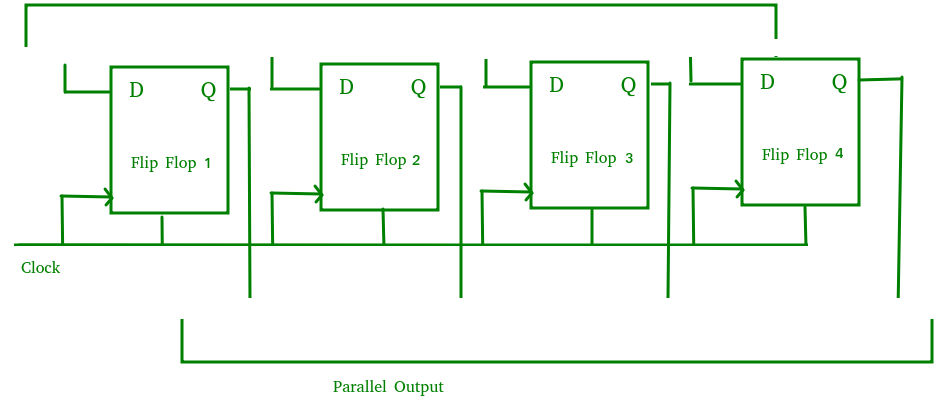
A Parallel in Parallel out (PIPO) shift annals is used as a temporary storage device and like SISO Shift register information technology acts as a filibuster element.
Bidirectional Shift Register –
If we shift a binary number to the left by one position, information technology is equivalent to multiplying the number past 2 and if we shift a binary number to the right by 1 position, it is equivalent to dividing the number by ii.To perform these operations we need a register which tin can shift the data in either management.
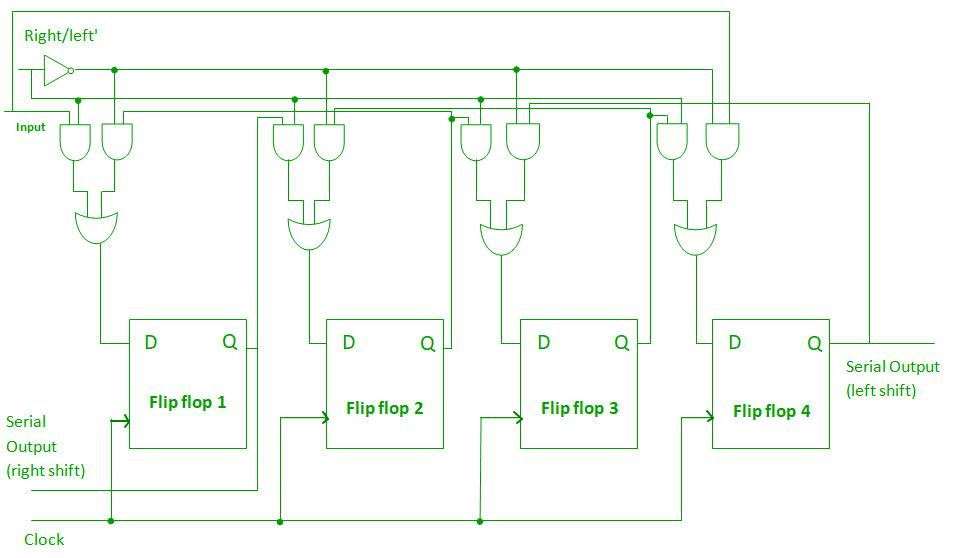
Bidirectional shift registers are the registers which are capable of shifting the information either right or left depending on the mode selected. If the mode selected is i(high), the information will be shifted towards the right direction and if the mode selected is 0(low), the data will be shifted towards the left direction.
The logic excursion given below shows a Bidirectional shift register. The circuit consists of four D flip-flops which are continued. The input data is connected at two ends of the circuit and depending on the way selected merely one and gate is in the agile state.
Shift Register Counter –
Shift Annals Counters are the shift registers in which the outputs are connected back to the inputs in order to produce particular sequences. These are basically of two types:
- Band Counter –
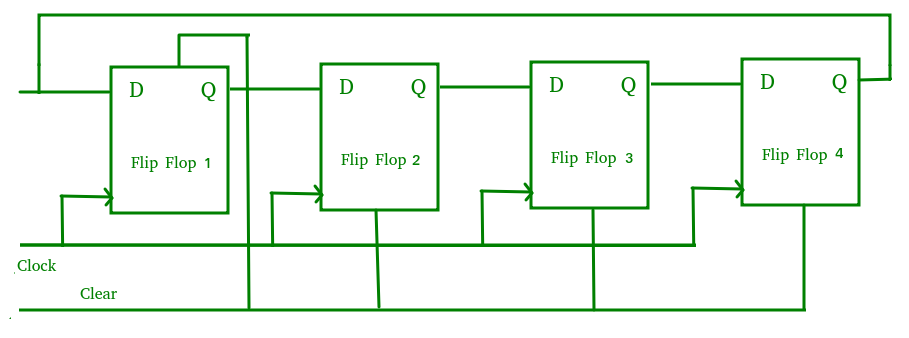
A ring counter is basically a shift register counter in which the output of the offset flip bomb is continued to the next flip bomb and and so on and the output of the final flip flop is again fed back to the input of the first flip flop, thus the name ring counter. The data pattern within the shift register volition circulate as long every bit clock pulses are applied.
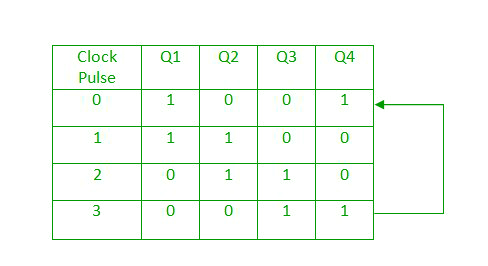
The logic circuit given below shows a Ring Counter. The excursion consists of iv D flip-flops which are connected. Since the circuit consists of iv flip flops the data pattern will echo after every 4 clock pulses as shown in the truth tabular array below:
A Ring counter is generally used because information technology is self-decoding. No extra decoding excursion is needed to determine what country the counter is in.
- Johnson Counter –
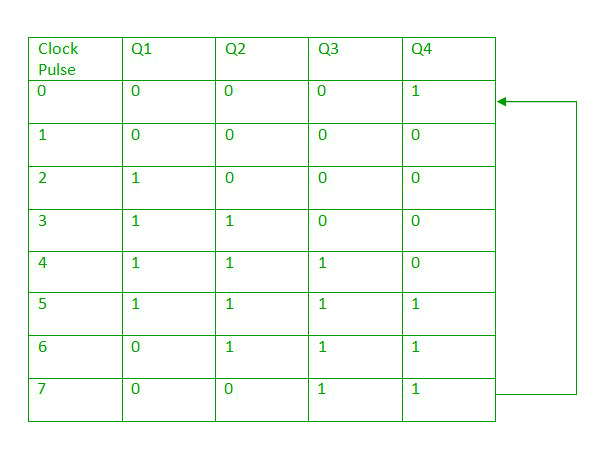
A Johnson counter is basically a shift register counter in which the output of the get-go flip flop is continued to the next flip flop and so on and the inverted output of the terminal flip flop is again fed back to the input of the first flip bomb. They are also known as twisted ring counters.The logic circuit given below shows a Johnson Counter. The excursion consists of four D flip-flops which are continued. An n-stage Johnson counter yields a count sequence of 2n different states, thus also known as a mod-2n counter. Since the circuit consists of iv flip flops the information pattern will repeat every eight clock pulses as shown in the truth table below:
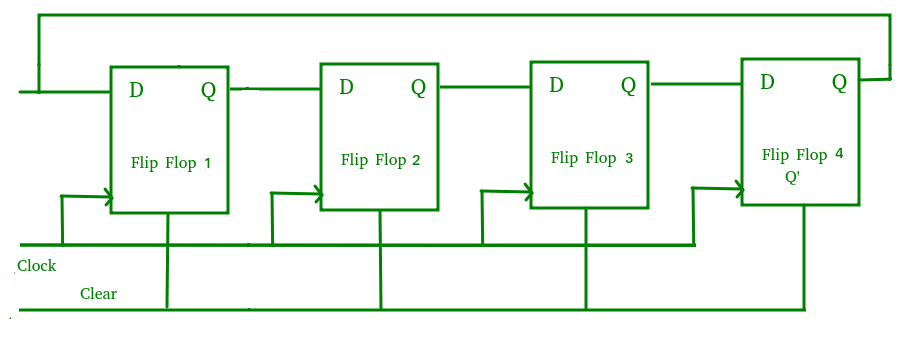
The principal advantage of Johnson counter is that it only needs northward number of flip-flops compared to the ring counter to circulate a given data to generate a sequence of 2n states.
Applications of shift Registers –
- The shift registers are used for temporary data storage.
- The shift registers are also used for information transfer and information manipulation.
- The series-in serial-out and parallel-in parallel-out shift registers are used to produce time delay to digital circuits.
- The serial-in parallel-out shift annals is used to convert serial information into parallel information thus they are used in communication lines where demultiplexing of a data line into several parallel line is required.
- A Parallel in Serial out shift register us used to convert parallel information to serial data.
Reference –
Registers – ee.usyd.edu.au

How Much Current Does The Shift Register Draw,
Source: https://www.geeksforgeeks.org/shift-registers-in-digital-logic/
Posted by: walterssweas1972.blogspot.com
0 Response to "How Much Current Does The Shift Register Draw"
Post a Comment